I’ve been comparing English translations made from the Codex Chrisianus 45 and Papyrus 967(only the NETS English translation), and making my own translations as well. I can no longer think that specifically: a secular ‘agreement with many’ made by a ‘prince to come’ is definitively a single trigger the sets off the 70th week of Daniel.
It’s possible to purchase Henry Barclay Swete’s Old Greek Septuagint 1st edition, digitally from Logos; (The only ‘book’ version is the extremely problematic 2nd edition, which is based on Theodotian’s Dan. 9). There’s a new, good translation by NETS that incorporates Papyrus 976 into the Chisianus 45 codex. NETS just started selling a book in addition to their digital version. I thinks its good to have at least those two but really having all of them is best. (Even the badly translated ones can be useful for some verses.) If I hadn’t begun comparing them all, and if not for translating the O.G. myself I think I’d be kind of lost regarding Daniel.
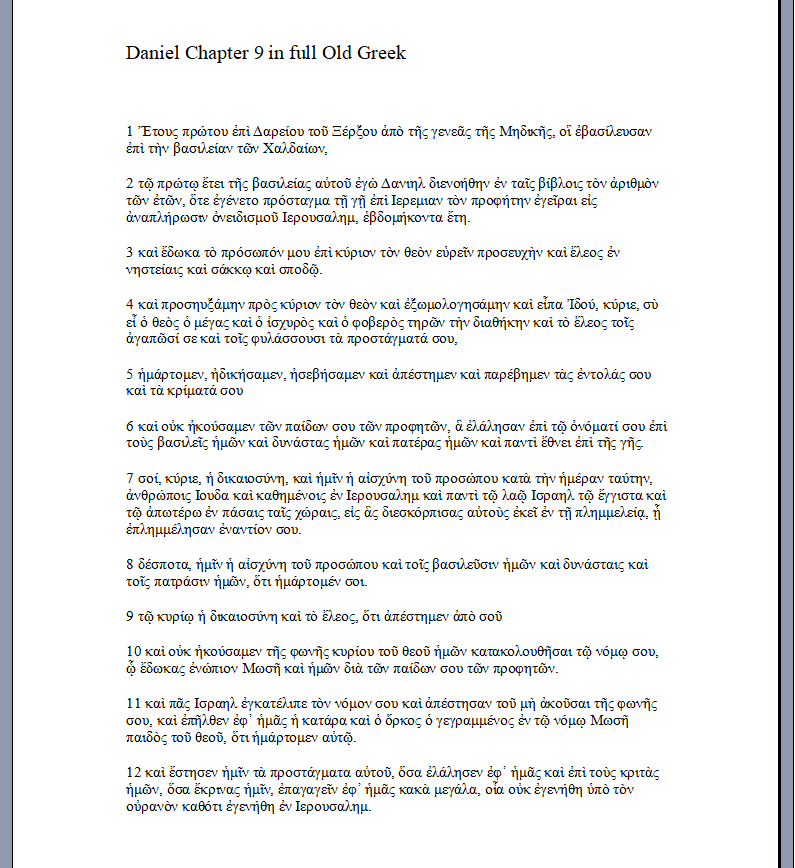
Daniel Chapter 9: 1-12 This text is from the Codex Chisianus 45 only. If anyone knows how to get Papyrus 976 untranslated, I’d really appreciate it if you’d email me about it. My address is at the bottom of the page.
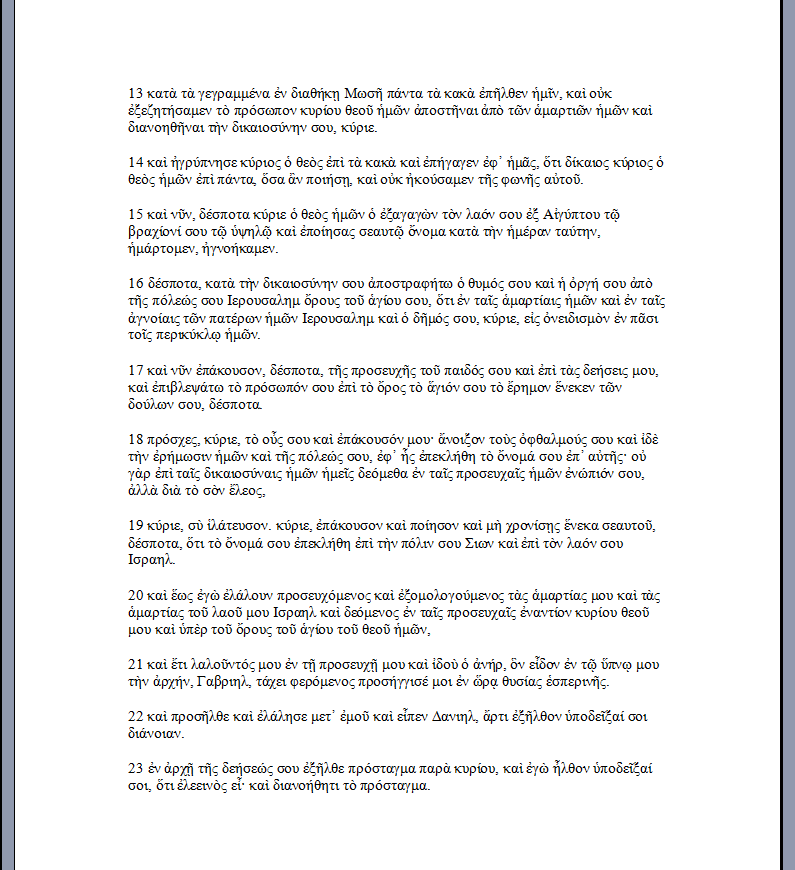
Codex Chisianus 45, Daniel Chapter 9: 13-27
Codex Chisianus 45, Daniel Chapter 9: 24-27 only :
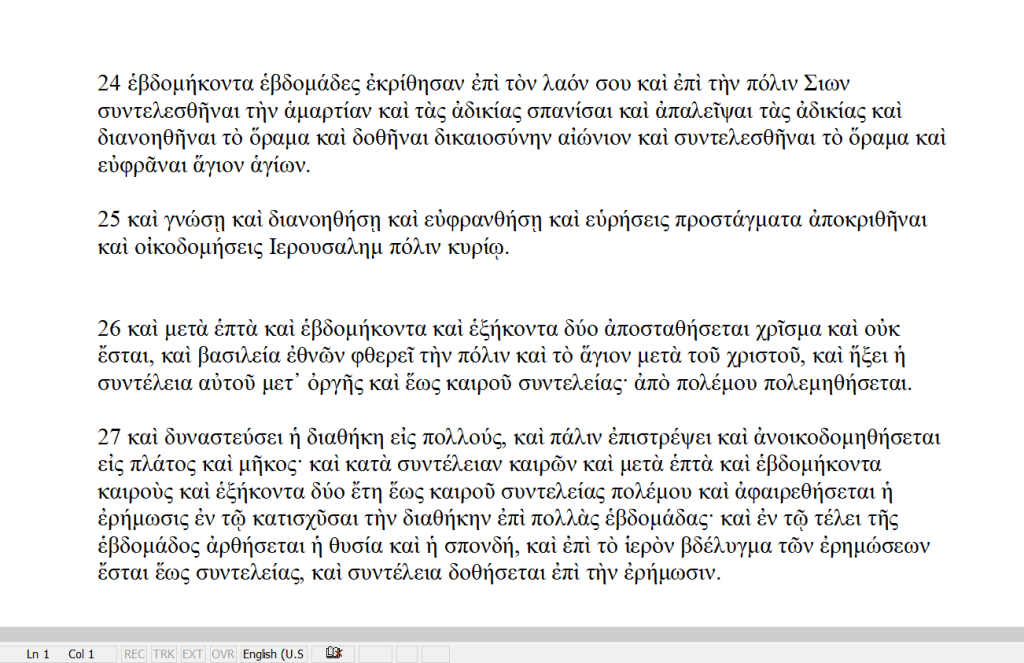
I’m sorry I couldn’t post that in digital form. It’s an image. It’s safer this way. I’ve already been attacked by “. . .” regarding this very document!
Here’s my very first best effort, put into readable shape, a translation based on other dictionaries, only using Strongs as a backup reference.
My best effort as of 8-2-25:
Daniel 9:27
Many will align with a ruler/prince who will bring back to life The Covenant (Mosaic), rebuilt with length and width according to end time standards, after 7 x 70 appointed times (Shmita cycles), also with 62 clansmen (temple guards).
Until, at the right moment for the consummation of joint (sin) debt payment, war will be against it, attempting to desertify it. The covenant will be greatly prevailed upon after many weeks.
By the time the ‘weeks’ will be taken away, sacrifice, libation and the great sacred thing, (the ark of the covenant) it (the Mosaic Covenant) will have reached its perfect/fulfillment.
An abomination making desolate will exist until a joint (sin) debt payment is given – great desertification.
I found out the word translated as ‘years’ also means ‘men of age’ or clansmen in what was a common Greek expression. King David had had 62 temple guards. Since we are talking about the temple, the clansmen must be temple guards. See: 1 Chronicles 26
Strong’s numbers rough version below. It’s not good enough because Strongs only uses the words from King James Version.
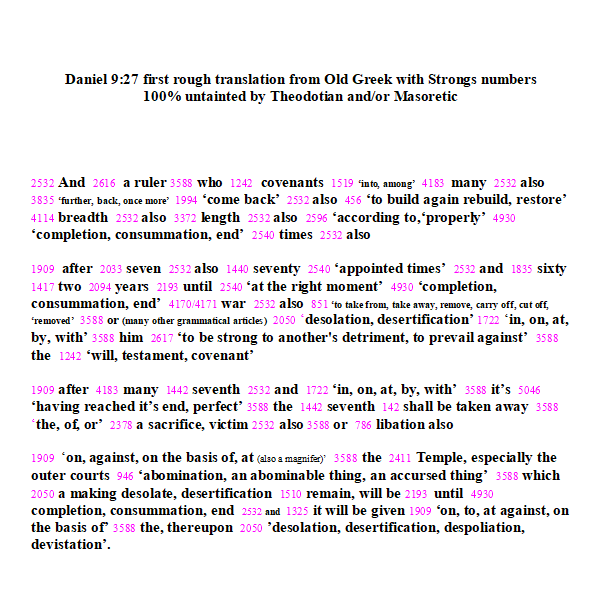
This was my second draft translation of Daniel 9:27. I used Strong’s for the basic foundation.
First attempt to make it read:
27. . .also A ruler who covenants among many, furthers his agenda by returning and rebuilding (the Temple) breadth and length according to end times (completion/consummation). . . and
. . . After seven and seventy appointed times, and sixty two years, until the right moment – of the consummation/completion/end – there’s WAR, which is also to remove, cut off or take away the desolation, with him who’s been prevailing strongly to the detriment of the others of the covenant.
After many seventh’s, and at it’s having reached its perfect end, the seventh shall be taken away, the sacrifice and/or libation also.
To reach me by Email: Taylor.blaise777@goldfishgateway.com
Blessing and keep watching!
 AlephTav.blog
You must be logged in to post a comment.